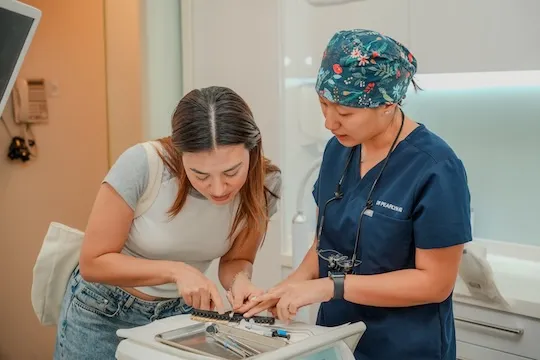
For a good number of people, the difficulty with going to the dentist is not the treatment itself but everything their nerves attach to it — sometimes a long way ahead of the appointment, sometimes from the first phone call. It is a common feeling, and a perfectly reasonable one. Sedation dentistry exists for exactly this: to make the experience calm and manageable for someone who would otherwise find it hard, so that the care they need does not keep getting postponed. It is worth understanding what it is, what it is not, and who it genuinely helps.
What sedation dentistry is
Sedation is a way of helping a patient stay relaxed and settled through an examination or procedure. A measured dose of a sedative — given before or during treatment — eases the tension without putting you to sleep. For most forms, you remain awake and aware throughout; you are simply calmer, more comfortable, and less troubled by the things that would ordinarily set the nerves going. It is not the same as general anaesthesia, and for most dental work it is a lighter, more straightforward arrangement than that.
The aim is modest and practical: to take the edge off, so the treatment can be done well and the visit remembered as unremarkable.
The common forms
There are a few approaches, chosen to match the person and the procedure rather than ranked against one another.
Inhalation sedation — nitrous oxide, sometimes called laughing gas — is breathed in through a small mask. It works quickly, leaves you relaxed but awake, and wears off almost as soon as the mask comes off, which is why most people are clear to drive themselves home afterwards. It is a gentle, well-established option, and a sensible first choice for milder anxiety.
Intravenous sedation is the deeper form, given through a vein by an anaesthetist. It suits longer or more involved procedures, or patients whose anxiety is more pronounced. You stay awake but deeply relaxed, and afterwards you are monitored until you are properly ready to leave and accompanied home. Because it is administered and watched over by a trained anaesthetist, the dose is adjusted continuously to keep you both comfortable and safe.
General anaesthesia, which renders a patient fully unconscious, is reserved for particular cases. It carries more to consider than the lighter options and is rarely the right tool for routine dental work — which is part of why sedation, rather than full anaesthesia, is what suits most people who simply find treatment stressful.
Who it tends to suit
Sedation is not only for severe anxiety. People come to it for a range of practical reasons, and it is worth recognising yourself in any of them: a strong gag reflex that makes ordinary treatment uncomfortable, difficulty keeping the mouth open for long stretches, sensitive nerves or a low tolerance for discomfort, a wish to combine several procedures into fewer visits, or simply a long-held unease about the chair that has never quite eased on its own.
It is matched to the procedure as much as the person. An anaesthetist is on hand for the more complex surgical cases — wisdom-tooth removal or implant surgery, for instance — where keeping a patient relaxed and still genuinely helps the work. For routine cleaning and check-ups, sedation is usually unnecessary, and we would say so rather than reach for it by default.
How we approach it
Where someone tells us they find treatment difficult, the first step is to understand the shape of it — what specifically is hard, and how much. From there we talk through the options plainly, explain what each would feel like, and agree on the lightest approach that will do the job. Nothing is decided for you. The point of sedation is not to push through a treatment you dread, but to remove the reason it felt like something to dread at all.
For patients whose anxiety is bound up with breathing comfortably during treatment, or who already manage an airway or sleep-related condition, we factor that into the plan as well — comfort and safety are read together, not separately.
If this resonates
If unease about dental treatment is the thing that has kept you from the care you need, that is worth a conversation rather than another postponement. Arrange a consultation and we will talk through what would make the experience manageable for you — calmly, at your pace, and with no commitment to anything until you are comfortable with it.