
“How much of my teeth will be trimmed?”
It is one of the first things patients ask me when they sit down to talk about veneers, and it usually arrives with a small wince — bracing for the answer they assume is coming. It is a fair question, and a more interesting one than it looks, because the honest reply is often the opposite of what people expect: usually far less than you would think, and sometimes nothing at all.
The reason surprises people. How much of a tooth we prepare is not decided by the veneer. It is decided by how your smile is going to look — and that is a question of design, worked out before any instrument goes near a tooth.

A minimal-prep veneer builds the result by adding a thin, carefully shaped layer of ceramic rather than cutting healthy tooth away — so much of the enamel underneath stays intact.
The hard part is the judgement: knowing exactly how little trimming a tooth actually needs.
Why teeth used to be trimmed more
For a long time, taking a tooth down was simply how veneers were done — and there was a real reason for it. The earlier generations of veneer ceramics were weaker and more opaque. To look natural and to survive the daily work of a bite, they needed a certain thickness. To make room for that thickness without leaving the tooth looking bulky, the dentist had to reduce the tooth first. Heavy preparation was, in large part, a workaround for the limits of the material. That is no longer the world we work in.
Modern veneers are stronger
Ceramics have improved enormously — they are stronger, and they handle light far more like real enamel than they used to. Just as importantly, we understand adhesion, the science of bonding ceramic to tooth, much better than a generation ago. A well-bonded thin veneer today can do what once only a thicker, more invasive one could.
The instinct to prepare heavily is still around, partly out of habit and partly because it is how many dentists were first taught. But the reason that instinct existed has largely gone. The material no longer demands it. What remains is a choice.
Why doing less is the harder skill
Here is the part that surprises people most: removing more of the tooth is, for the dentist and the ceramist, the easier path — not the harder one.
Take a tooth down to a smooth, even shape and you hand the ceramist something close to a blank canvas. It is forgiving. There is room to build, room to correct, room to quietly absorb a small misjudgement inside the extra thickness. Everyone’s job gets simpler — except the tooth pays for it biologically.
Design the finished smile first
Working thin removes that cushion, and to do it well the thinking has to happen first. There is an approach I lean on heavily here, developed by the aesthetic dentist Galip Gürel, in which we build the finished smile first — as a mock-up, before preparing anything — and then measure everything backwards from that final shape. It sounds like a small reordering. In practice it changes everything, because it tells us exactly how much space already exists between where your teeth are now and where the design wants them to be.
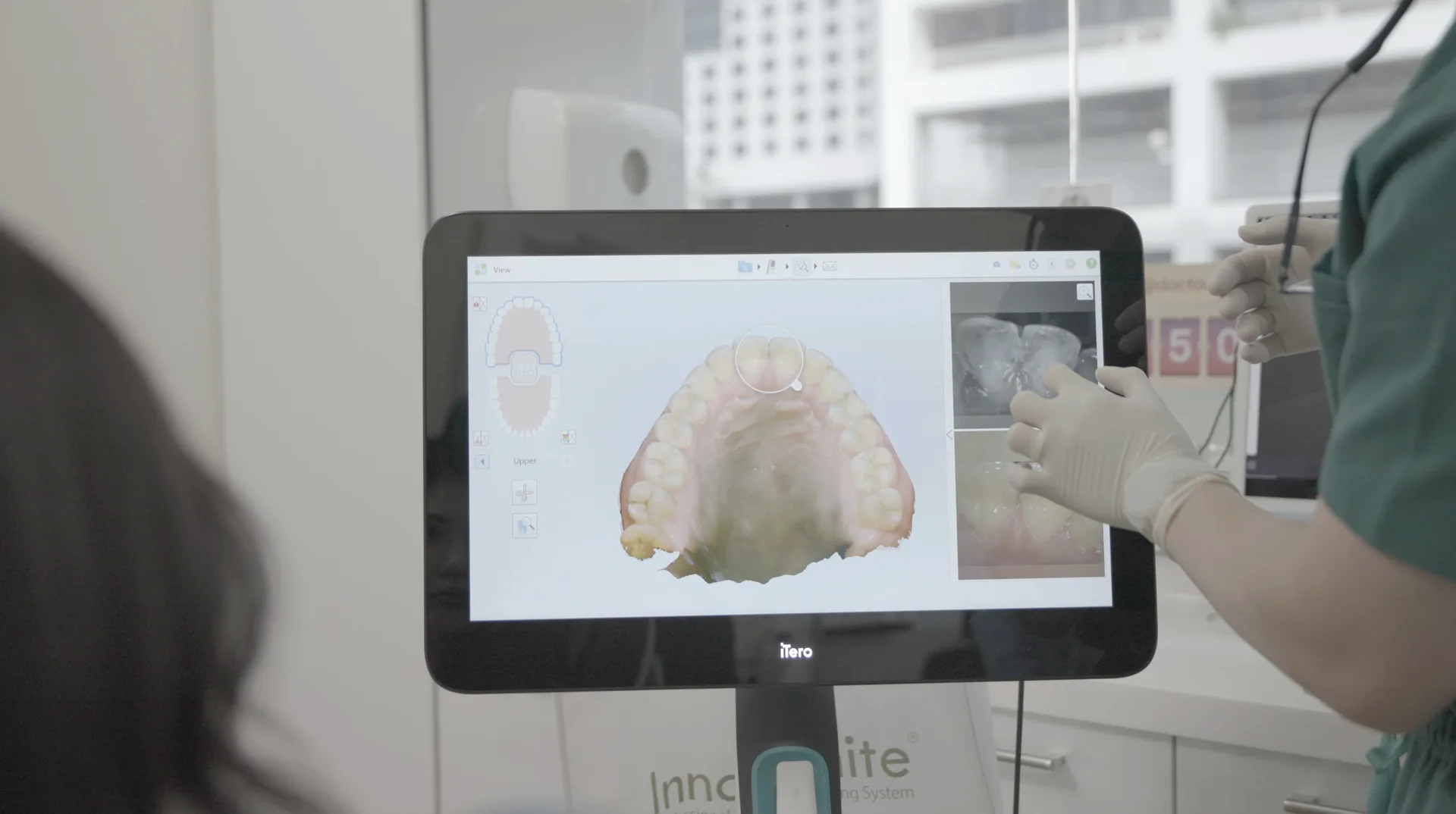
How much trimming do you actually need?
A veneer is thin — around 0.5mm, roughly the thickness of your thumbnail. So the real question is never “how much do we trim to make 0.5mm of room?” It is: how much room is already there?
Often the answer is: enough. If the designed smile sits 0.5mm or more outside where your tooth is now, no trimming is needed at all — the space is already yours. Where a tooth is slightly rotated or set back, we might remove a whisper in one place — say 0.2mm here, nothing at all there — only so it can meet its position in the final design. The endpoint decides the preparation. Not the other way around.
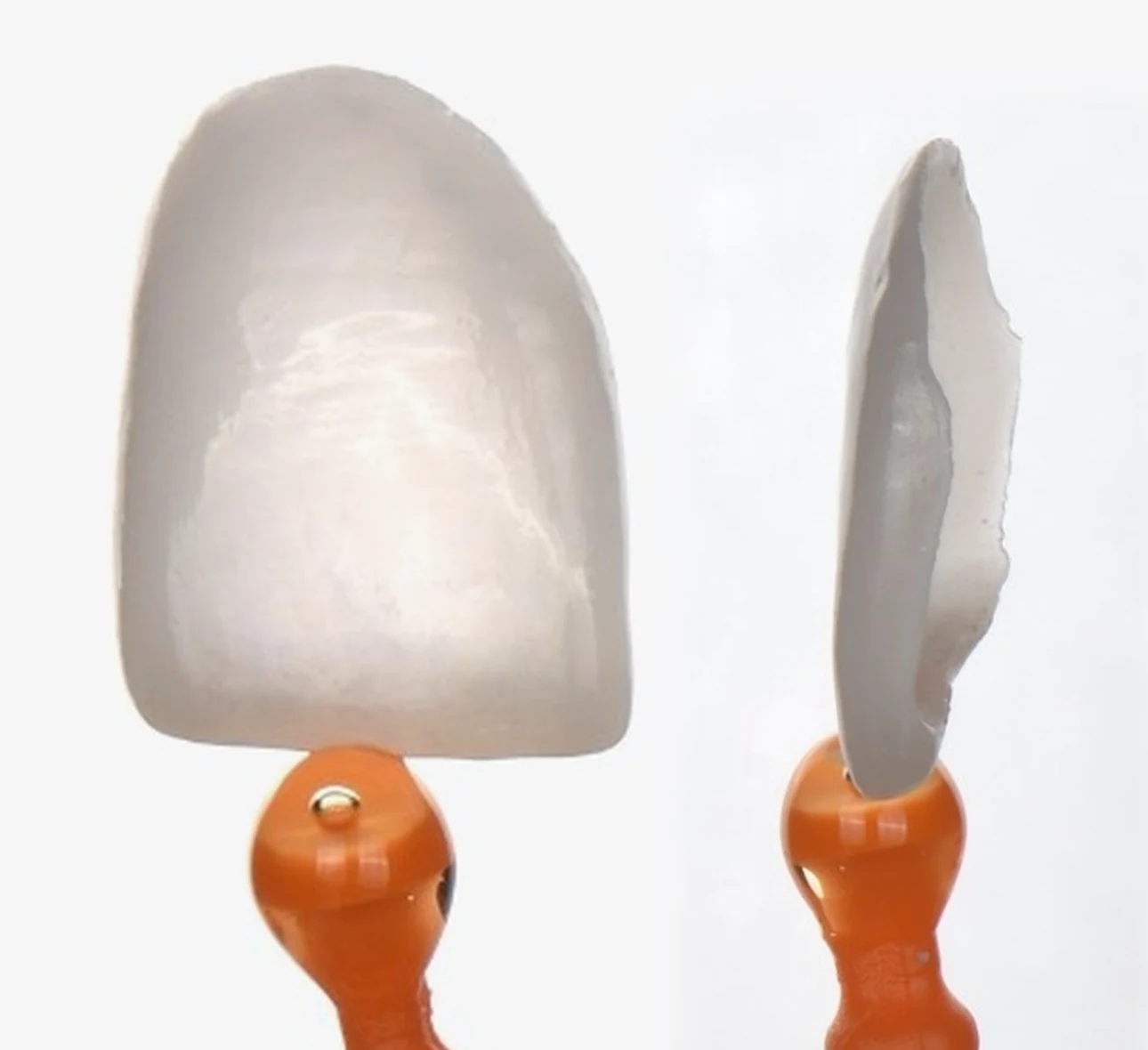
The same veneer, face-on and turned on its edge — about half a millimetre of ceramic.
Once the smile is designed, the room it needs is often already there.
But is a veneer that thin strong enough?
It is — and understanding why is the whole point.
Where the strength comes from
A thin veneer is not asked to be strong on its own. It borrows its strength from the tooth beneath it and from the bond between the two. Done properly, the veneer and the enamel behave as a single piece.
Precise bonding
That bond is where the real work lives. Measured, selective preparation takes far more time and attention than grinding a tooth to a uniform shape — you are removing a fraction here, nothing there, each decision guided by the design rather than applied across the board. And bonding a 0.5mm veneer reliably is genuinely demanding: the surfaces must be immaculate, the sequence exact, the ceramic handled with real care.
The shortcut that costs the tooth
Here is the uncomfortable truth underneath all of it. If you prepare a tooth heavily and then bond it poorly, it will still work — the veneer is thick enough to hold together largely on its own. The tooth quietly pays for that shortcut.
A thin veneer offers no such cover: it only works if the bonding is excellent. The conservative approach, in other words, is the one that asks the dentist to be genuinely good at the difficult part.
Anyone can make a tooth look different by removing more of it. The craft is making it look right while removing almost none.
None of this is taught in dental school by default. Bonding at this level comes from specialised courses, from working through cases under mentorship, and from practising somewhere that expects it — and it is a skill that never really stops improving.
Why we think it is worth the trouble
If heavy preparation still produces a good-looking smile, why insist on the harder road? A few reasons — and none of them are about how the smile looks on the day.
Enamel doesn’t grow back
The reason I am so deliberate about this is simple: removing healthy tooth structure is a one-way door. Enamel does not grow back. A conservative approach today keeps tomorrow’s options open — a conservatively treated tooth can be repaired, refreshed, or revised as life goes on, in a way that a heavily prepared one cannot be un-prepared.
Problems you can still spot early
The second reason is quieter, but it matters just as much. Over the years, one thing we watch for is leakage — where the seal at the edge of a veneer begins to fail and saliva and bacteria find their way underneath. Caught early, it is a straightforward fix; left unseen, it can decay the tooth from within, beneath the restoration. When most of your natural tooth is still there, that trouble is far easier to see and to put right. On a heavily prepared tooth, the same problem can hide until it has done real damage. Keeping the tooth largely intact keeps a problem visible — and a visible problem is a fixable one.
0.5mm — the number to remember
If you have noticed 0.5mm coming up again and again, that is not an accident — it sits close to the heart of this. But the takeaway is not the number. It is what the number is measured from.
0.5mm from the final position of your smile — not 0.5mm off your tooth.
That single shift — from thinking about what is taken off the tooth to thinking about where the tooth is headed — is what separates preparation that serves the smile you are designing from preparation that merely serves the veneer.
So when a patient asks whether they need to trim their teeth, my honest answer is usually the same: let us design where your smile is going first, and then we will know — and the amount is very often less than you feared, sometimes none at all. If you would like a view that begins from how little your teeth might need rather than how much, come and have a chat. I will tell you plainly what I see — including, quite often, that the answer is not much at all.