The Celebrity Magic of Porcelain Veneers
Dr. Leroy Kiang
What makes some porcelain veneers look natural while others look obviously fake? The difference comes down to material quality, ceramist skill, and smile design precision.

The phrase "celebrity smile" has become shorthand for porcelain veneers — and not always in a flattering way. For every set of veneers that looks effortlessly natural, there are examples that look uniform, overly white, and visibly artificial. The difference is not the material. It is the process.
Understanding what separates well-made veneers from poorly made ones is useful for anyone considering the procedure, because the fear of looking "fake" is one of the most common reasons patients hesitate.
[[hr]]
Why some veneers look artificial
The most common causes of unnatural-looking veneers are surprisingly straightforward:
Uniform colour. Natural teeth are not a single shade. They are slightly warmer near the gum line, more translucent at the edges, and vary subtly from tooth to tooth. Veneers made in a single flat shade — even if that shade is technically "white" — read as artificial because they lack this variation.
Identical shape. Natural teeth have slight irregularities — a rounded edge here, a slightly shorter lateral incisor there. When every veneer is shaped identically, the result looks manufactured rather than organic.
Wrong proportions for the face. Teeth that are too long, too square, or too wide for the patient's facial structure create a disconnection. The veneers may look fine in isolation but wrong on the person wearing them.
Excessive opacity. Natural enamel is slightly translucent — light passes through it, giving teeth their depth and vitality. Cheaper porcelain or poor layering technique produces opaque veneers that sit on the surface of the smile rather than integrating with it.
[[hr]]
What makes veneers look natural
The veneers that look convincingly real share several characteristics, all of which trace back to the clinical process:
Personalised smile design. Before any preparation begins, the dentist analyses facial proportions, lip dynamics, gum symmetry, and how the patient's smile moves during speech and laughter. The veneers are designed for the person — not selected from a template.
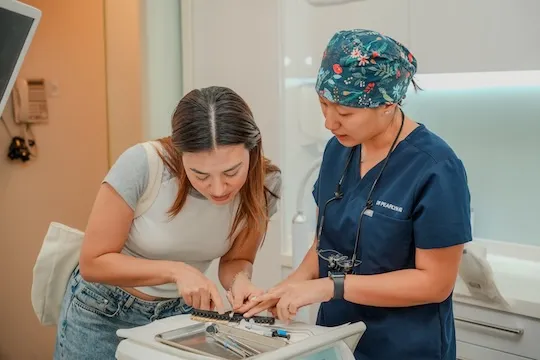
Hand-layered ceramics. The ceramist builds each veneer in layers, controlling the colour gradient from gum line to edge and introducing subtle translucency and surface texture. This is painstaking work and cannot be replicated by mass-produced or digitally milled veneers alone.
Direct dentist-ceramist collaboration. When the dentist and ceramist work together in the same practice, adjustments to shade, texture, and translucency happen in real time. There is no back-and-forth with an external laboratory, no miscommunication about what "natural" means for this particular patient. The ceramist can see the patient's face, skin tone, and existing teeth — information that does not translate well into a lab prescription form.
Conservative preparation. Removing the right amount of enamel — enough to create space for the porcelain without over-reducing the tooth — ensures the veneer sits at the correct depth. Over-preparation leads to thicker veneers that look bulky; under-preparation leads to veneers that protrude.
[[hr]]
The role of experience
Porcelain veneers are among the most technique-sensitive procedures in dentistry. The margin for error between "natural" and "artificial" is measured in fractions of a millimetre and subtle shifts in shade.
This is where case volume matters. A dentist who has placed thousands of veneers has encountered the full range of tooth shapes, gum types, skin tones, and patient expectations. They have seen what works and what does not — and that pattern recognition informs every decision from smile design through to final bonding.
Similarly, a ceramist who builds veneers daily develops a refined eye for the micro-details — the surface texture that catches light correctly, the translucency gradient that makes porcelain read as enamel, the contact points that feel natural when the patient runs their tongue across them.
[[hr]]
Beyond aesthetics: function and longevity
Veneers that look natural also tend to last longer, because the same precision that produces a good aesthetic result — accurate preparation, proper material selection, and careful bonding — also produces a mechanically sound restoration.
Well-made porcelain veneers last 15 to 25 years. Poorly made ones may chip, debond, or discolour within a few years, requiring early replacement and additional cost.
The initial investment in quality — in materials, in the ceramist's time, in the thoroughness of the smile design process — pays for itself over the life of the veneers.
[[hr]]
Porcelain Veneers in Singapore
The "magic" of porcelain veneers is not magic at all. It is material science, clinical skill, and the patience to get the details right.
The veneers that look effortlessly natural are the ones where the most work went into making them appear that way.
If you are considering veneers and want to understand what the process involves, our SmileUp Veneers programme includes a comprehensive smile analysis, personalised design, and in-house ceramic fabrication — the combination that produces results you stop noticing because they look like they belong.
Aesthetic Dentistry
— Need help?
Whether you're considering porcelain veneers, Invisalign, or dental implants — Orchard Scotts Dental brings 19 years of aesthetic and restorative expertise, 4,200+ smile transformations, and Black Diamond Invisalign status (top 1% in Asia-Pacific).